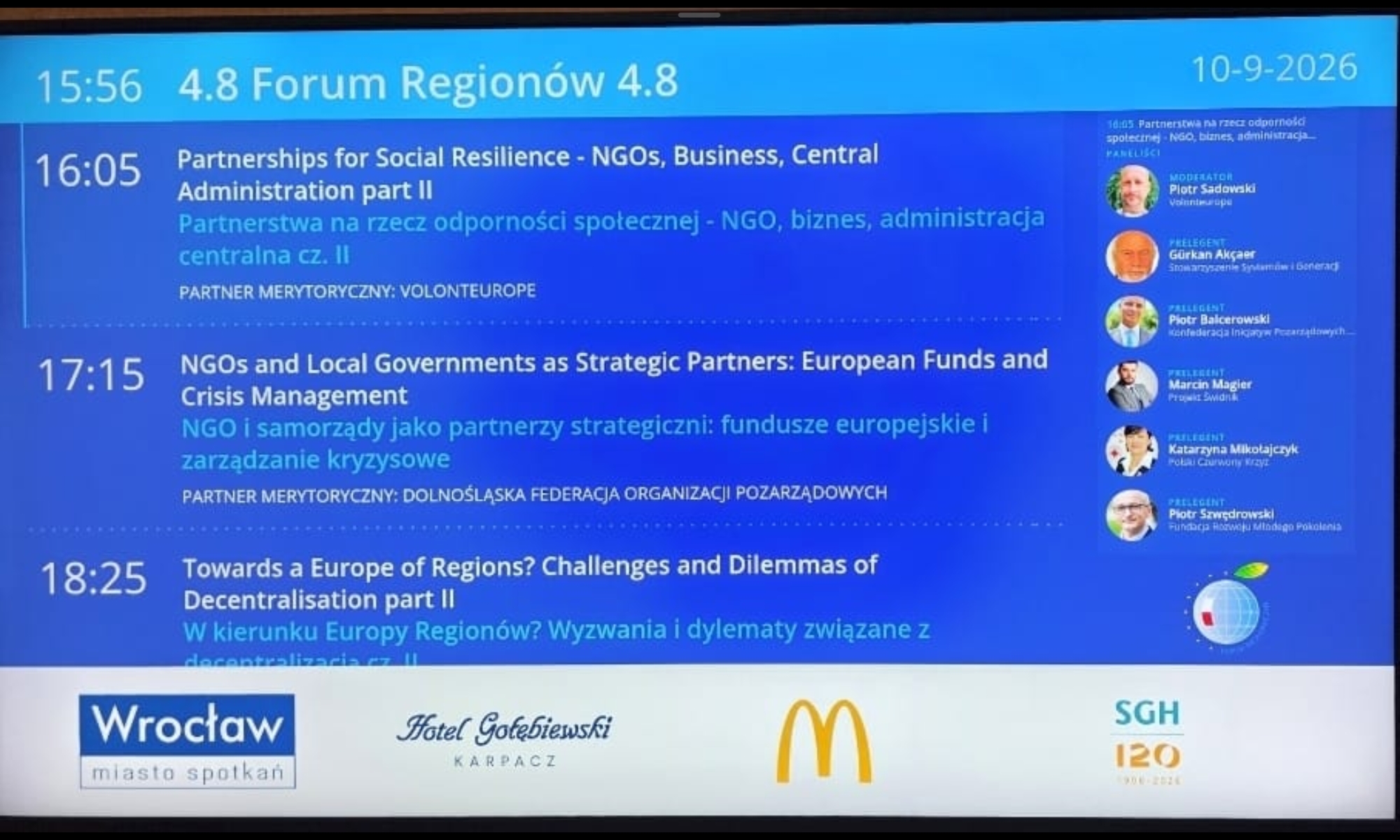

Dear Moderator, distinguished guests, and fellow panelists, warm greetings to you all.
From the perspective of System and Generation Association—and as the Coordinator of the Anna Lindh Foundation Turkish Network—we define social resilience not merely as the ability of communities, particularly youth and vulnerable groups, to survive crises and rapid changes, but as their capacity to adapt, innovate, and actively participate in civic life.
We build this resilience every day through our strategic cooperation with the Turkish National Agency under the Ministry of Foreign Affairs, on-the-ground partnerships with local authorities, our extensive NGO network, and intercultural dialogue mechanisms spanning the Euro-Mediterranean region.
So, what are the risks if cross-sector partnerships in this space fail or remain underutilized?
First, the Gap Between Policy and On-the-Ground Reality.
Central administrations and National Agencies provide essential policy frameworks. However, without integrating the implementation power of local governments and the flexible, trust-based local reach of NGOs, policies remain on paper. Social resilience breaks whenever it fails to reach the grassroots level.
Second, Fragmentation and Wasted Resources.
When sectors work in isolation—in silos—effort is duplicated. If we fail to combine the resources of the private sector, the scaling power of central government, the logistical strength of local municipalities, and the social innovation capacity of NGOs, valuable time and funding are wasted.
Third, and most dangerously, the Erosion of Social Cohesion and Trust.
If these cross-sector mechanisms fail to react collectively during crises, disillusionment deepens among young people and marginalized communities. Where dialogue—from local to international levels—is severed, polarization and social exclusion rapidly take root.
In summary: Central government shapes the vision, local authorities implement, the private sector empowers, and NGOs bridge the human connection. If even one of these links breaks, we cannot speak of true social resilience.
Thank you.
In our context, the model that works best—and the one I believe is most replicable across Europe—is what we can call the "Multi-Level Local-to-International Bridge Model."
Rather than relying on top-down instructions or purely isolated grassroots projects, this model connects four key pillars into a single operational pipeline:
The Policy & Funding Engine: Central government bodies and institutions like the Turkish National Agency (under the Ministry of Foreign Affairs) provide the institutional backing, quality standards, and European frameworks (like Erasmus+ and the European Solidarity Corps).
The Local Implementation Ground: Municipalities and local authorities provide infrastructure, youth centers, logistical support, and direct access to local citizens.
The Human Connection & Innovation: NGOs like System and Generation Association bring agility, non-formal education tools, and direct trust with young people and vulnerable groups.
The Regional Cross-Border Scale: Networks like the Anna Lindh Foundation scale these local successes across the broader Euro-Mediterranean region through intercultural dialogue.
Why is this model highly replicable across Europe?
It isn't reinventing the wheel: It uses existing European funding mechanisms and policy priorities—such as inclusion, green transition, and digital transformation—and grounds them in local municipal needs.
It de-silos resources: Municipalities often have space and infrastructure but lack international youth outreach; NGOs have methodology and youth networks but lack physical scale; central agencies have funds but need grassroots impact.
A concrete example of this is how we respond to social crises or youth unemployment: we co-design local youth activities alongside municipalities, back them with National Agency grants, bring in local businesses for skills-matching, and share the outcomes across our Mediterranean NGO partners.
When you connect the policy level, municipal level, and civil society level into a continuous loop, social resilience stops being just a theoretical concept and becomes a daily, operational reality.
Here is a punchy, memorable 1-minute closing response designed to end on a strong note, concluding with a single, clear vision sentence:
Looking ahead five years, true resilience means moving away from reactive, one-off projects and establishing permanent ecosystem cooperation.
When central agencies provide the strategic vision, municipalities supply the infrastructure, businesses bring investment and innovation, and NGOs anchor the human connection, we stop managing crises after they happen and start building resilient communities before they occur.
"Five years from now, a successful partnership is one where government, business, and NGOs no longer meet just in times of crisis, but operate as an integrated, everyday ecosystem where policy, resource, and civil action seamlessly turn societal challenges into shared, lasting resilience."
Thank you.
With Special Thanks to:
Mrs.Pola Lewicka
Specialist for Balkans
Foundation Institute for Eastern Studies
Organiser of the Economic Forum